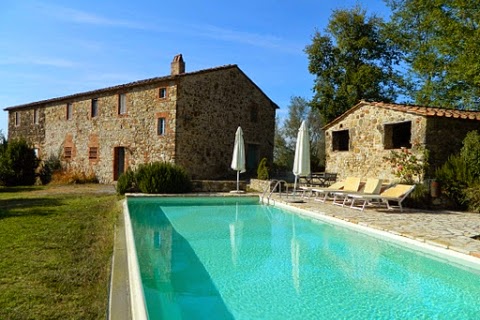
Autumn holidays in Italy; smart prices, less crowds and plenty of sunshine


Most tourists visit Italy predictably in the high season months of June, July and August.  You also have to remember that millions of Italians themselves staycation in Italy (can you blame them?) mostly during August. Even September in Italy these days but towards the end of September and October really is a magical time to visit!


Visiting outside of peak season will bring lots of benefits to the potential visitor. Prices for a start are significantly lower and can range from 25% to 50% less than high season – you can normally cherry pick your choice of self-catering villa or apartment with ease.  The weather tends to still be good in September and often well into October in many regions – it can drift easily into the late 20’s in most places but obviously cooler in the mornings and evenings and becomes a little more unsettles to add even more drama to the beautiful landscape. A refreshing change to the often stifling heatwaves of July and August.


Visiting Italy in the autumn will often help you to discover the real regions; visiting historical hamlets and villages without the midsummer crowds, and driving on quiet country roads with crisp blue skies can really be a joy.


Another benefit is the fantastic food. Italian food is always wonderful but during this period, many areas will boast festivals and start harvest season showcasing their local produce.

In terms of activities, it is also perfect for a game of golf and other activities of interest such as sailing and diving, horse riding and fishing.

Where to visit

Autumn is fab all over Italy but here is our pick of areas:

Lake Garda – We love the lakes but they can get so crowded over summer with too many campervans heading down from northern Europe. Once the Italians are back to work and the high season families have scattered, Garda becomes elegant again and a real joy to navigate around.


Tuscany – One of our favourite places like many others but autumn really is a joy here are the roads are not congested and you are not surrounded by tourists at every turn. You can really see the true Tuscany and sample some of the wonderful food and wine.


Sardinia – Most would think of visiting earlier but the weather often holds out. What then remains is a beautiful island; tranquil, endless sandy beaches and enough space to find your own piece of paradise.


Sicily – similar to Sardinia, this island really shines in autumn. You will probably find some of the best weather all over Italy in Sicily in autumn, where the locals will often swim in the sea into November. A truly magical place.


Search our property portfolio for self-catering villas and apartments in Italy


"Real prospect of a custodial sentence" ~ Controversy over remands

Battle has been joined between the Magistrates Association and the Howard League ... allow me to explain.

The Bail Act 1976 determines whether or not a defendant will be granted bail (with or without conditions).  Refusal of bail has to be justified on the basis of one of the grounds set out in the Act.  Unfortunately, this Act has been so extensively amended over the years that it is exceptionally difficult to read.  Perhaps one day, Parliament will see its way to enacting a complete update!

One of the recent amendments relates to the so-called "real prospect" test - that is, whether there is a "real prospect" of the individual receiving a custodial sentence should he be convicted.  I will illustrate this by considering a defendant (James) who is charged with assault occasioning actual bodily harm (section 47 of the Offences against the Person Act 1861).  The alleged offence was not in domestic setting.


James need not be granted bail if the court is satisfied that there are substantial grounds for believing that he would:

a) fail to surrender to custody;
b) commit an offence when on bail;
c) interfere with witnesses or otherwise obstruct the course of justice.

It must also appear to the court, if James is over 18, that there is a real prospect of a custodial sentence if he is found guilty.

In making the bail decision, the court must have regard to criteria such as the nature and seriousness of the offence and the likely means of dealing with it; the character, antecedents, associations and community ties of the defendant; the defendant's record of fulfilling bail conditions; the strength of the evidence of the defendant's having committed the offence and any other criteria which appear to be relevant.

Whether there is a real prospect of a custodial sentence would clearly depend on the alleged prosecution facts being established.  Assuming that they are eventually established, the Sentencing Guidelines indicate whether there is a real prospect of a custodial sentence (see page 210 of the guidelines).  On the basis of those guidelines, bail could only be refused if the offence were to be either Category 1 or at the serious end of Category 2.  Category 3 would not suffice since, at most, a community sentence applies to this category..

The real prospect test was enacted in an effort to reduce the use of remands in custody.  The Howard League has expressed the view that there are still too many remands in custody of defendants who do not ultimately received a custodial sentence - Revealed: the millions spent on needless remands.  The Magistrates' Association takes issue with this - Magistrates Association response to Howard League remand figures

Where a Magistrates Court refuses bail, the defendant may appeal to the Crown Court.  Obviousdly, on such an appeal the defendant could argue that the real prospect test would not apply.

The Prosecution can now appeal to High Court against the decision of a Crown Court Judge to grant bail to a Defendant charged with or convicted of an imprisonable offence.  This provision is not available where the decision of Crown Court Judge was itself made on appeal from a decision of the Magistrates Court.

It MUST be noted that the Bail Act contains exceptions where the real prospect test does NOT apply.   These are not discussed in this post but see the links below.

One Paper Buildings issued a commentary on the changes to bail procedure made by LASPO

See also the summary issued by Number 6 of the LASPO changes 

Search Warrants

It is very long established law that Police Officers require lawful authority to enter the property of the individual - Semayne's Case (1604) 5 Co Rep 91; Entick v Carrington [1765] EWHC KB J98. Entry is often made lawful because the Police act under a warrant issued by a Magistrate - whether District Judge (Magistrates' Courts) or a Justice of the Peace - or, in some circumstances, by a circuit judge.   A key statute dealing with search warrants is the Police and Criminal Evidence Act 1984 Part II - sections 8-16.  

The High Court has been assiduous in ensuring that, if the validity of a search warrant is challenged, all statutory formalities have been complied with.  Formalities may relate to the actual issuing of the warrant or to its subsequent execution.  This is well illustrated by the case of Redknapp v City of London Police and City of London Magistrates Court [2008] EWHC 1177 (Admin) where a warrant, issued by a JP, was held to be unlawful for non-compliance with the Police and Criminal Evidence Act 1984 s8(3).  It is also clear from this judgment [para 13] that adequate notes should be kept by the court as to the material put forward  by the Police in support of their application for a warrant.  The warrant issued to search Mr Redknapp's home was executed and the press were present.  Although the High Court did not find that the press had been "tipped off" such an inference does not seem unreasonable.   The Redknapp case is discussed at some length by Neil Parpworth in Criminal Law and Justice Weekly - 13th December 2008.

The Berkshire home of Sir Cliff Richard
has been recently searched by the Police acting under a warrant issued by the Magistrates court.  The search took place when Sir Cliff was absent abroad and it took place in a blaze of publicity.  Geoffrey Robertson QC is highly critical of this - see his article published by The Independent on 16th August 2014.  Robertson sees the way in which Sir Cliff Richard has been treated as completely unacceptable.   Whether it was actually unlawful may yet be tested before the High Court.

A major concern is the attendant extensive publicity and South Yorkshire Police have admitted working with the media before searching the property.  As Robertson notes -

'People believe that where there’s smoke there’s fire, but sometimes there is just a smoke machine.
  By treating Cliff Richard as though he were a bank robber or a mass murderer, the police from Thames Valley and South Yorkshire, aided and abetted by the BBC and a Sheffield lay justice, have blasted his reputation around the world without giving him the first and most basic right to refute the allegation.'

The involvement of the media in this way may yet raise important issues relating to due process and fair trial (Article 6 of the European Convention on Human Rights).

Without knowing the full circumstances surrounding the issuing of the warrant, I hesitate to agree with Robertson that all search warrants should be issued by judges though, in fairness, the idea will not be without attraction to some.  In daily practice, "lay justices" - properly advised as to the relevant law - deal, in most cases, with these applications.  However, out of court hours, it is not unknown for the police to visit the home of a lay justice to ask for a warrant.  Perhaps, at the very least, a legally qualified legal adviser ought to be always present.  Magistrates' Courts have procedures in place for handling these applications.  In 2013, the Justices Clerks Society issued guidance - (HERE). The Magistrates' Blog has the following posts on search warrants

Search warrants (1) ........  Search warrants (2) .........  Search warrants (3)

and also see UK Police Law Blog

Other material:

PACE Code B -

Justices Clerks Society - Search warrants

The scandal of "endless" Police bail

Following the arrest of an individual, the Police are empowered to release the individual on bail.  Such bail may have onerous conditions.  The normal life of the individual may be seriously affected by such conditions. If the individual is on such bail for an extended period then it may be tantamount to some form of "extrajudicial" penalty.  The power of the Police to impose bail conditions stems from section 27 of the Criminal Justice and Public Order Act 1994.  Conditions imposed by an officer may be varied by the magistrates court on application by the suspect (section 47(1E) PACE).

The Crown Prosecution Service (CPS) has announced that in relation to an allegation of unauthorised computer access, an individual has been cautioned for an offence contrary to Section 1 of the Computer Misuse Act 1989.  This follows the arrest, some two years ago, of Times journalist Mr Patrick Foster as part of Operation Tuleta.   The Guardian 15th August has covered this story.  The lawyer and journalist David Allen Green has also extensively covered this case (and others) whilst writing for The New Statesman - e.g. 29th August 2012 Nightjack: arrest made and 12th April 2012 The Times and Nightjack: an anatomy of a failure.

Although there

is ordinarily a maximum of 24 hours that an arrested person can be questioned without charge, separate sessions of questioning not exceeding a total of 24 hours can be spread out over an unlimited period of time.  (In certain situations, questioning may take place for  longer than 24 hours).  The ability of the Police to "stop and start" the "PACE Clock" was the subject of legislation following the Hookway case in 2011 (previous post) - Police (Detention and Bail) Act 2011 (amending section 47 of the Police and Criminal Evidence Act 1984).   [Sidenote: Almost 3 years later, the government maintained and publicly available legislation database has not yet caught up with this important amendment to section 57].

The continuation of bail for lengthy periods has not been without comment.  For instance, as reported by The Guardian 29th September 2013, LIBERTY has called for a 6 month time limit to be imposed. The Law Society called for a 28 day limit - BBC 28th May 2013. 

As quoted in The Guardian article 15th August, Mr Foster stated:

.... that in order to bring this “regrettable episode to an end”, he decided to accept the offer of a police caution.  He described the “heavy handed police investigation” into something that happened when he was a 24-year-old junior reporter as a “nightmare”.  Foster said he did not know whether he would have been in charged if he had rejected the caution, but added that he could not “in good conscience” have risked putting his family “through many more months of heartache, and mounting legal costs”.  Foster has been unable to pursue his career as a journalist while in legal limbo over the past two years.  “No one should ever have to suffer the extrajudicial punishment of two years on police bail, and my sympathies are with others still languishing in this invidious position,” he said.

It is surely high time this sort of injustice was brought to an end ..............!

Crown Prosecution Service - Bail


See art in the making at Devon Open Studios

There's something about the West Country that attracts those with an artistic disposition. For some it's the captivating views, for others it's the unique personality of the place - the people, towns and traditions. Whatever the inspiration, the outstanding quality of art produced in this corner of Britain is truly something to be celebrated.

That's exactly why Devon Open Studios is so popular and enduring. From 6 – 21 September over 200 artists at over 140 venues across the length and breadth of Devon throw open their doors to the public - and invite you to visit them in their studios, many located in some of the most beautiful, unexplored parts of the county. There is so much to explore; painting and printmaking, ceramics and textiles, sculpture, jewellery, photography and more.

Now in its eighth year, Devon Open Studios provides a wonderful opportunity to meet the artists, find out what inspires their work, buy art direct from the creator, see demonstrations or even have a go yourself. As said, many artists also give demonstrations and show works in progress, allowing the rare chance to see the art being created and get a feel for the process from concept to completion.

Helpful Holidays is the main sponsor, as we have been for the last 4 years. We also sponsor the Devon Open Studios Emerging Artists Bursary Awards to encourage those taking their first steps into professional practice, returning to creative practice after a career break or change, or taking their art in a new direction. This year’s winners are showcased at a special exhibition at Thelma Hulbert Gallery in Honiton from 6 – 25 September.

This year’s winners are Rory Cunningham, Janet Sainsbury (picture above), Tessa Jane, Greg Newman and Elisa Cunningham. 

Lord Neuberger ~ Recent Speeches

Supreme Court of Victoria
Our own Supreme Court is now in vacation until the next legal year commences in October.   Lord Neuberger, the court's President, is busy in Australia and New Zealand delivering speeches.

In a speech at the Supreme Court of Victoria in Melbourne Lord Neuberger looks at the development of human rights law within the UK and its present day application.  He referred to some of the important issues such as the extent to which the Human Rights Act 1998 permits the courts to modify the literal meaning of a statute, when the courts will issue a declaration of incompatibility, the possibility (yet to be decided) that the convention might be applied "horizontally" so that obligations to respect the rights of others might apply to private entities.   He also considered the roles of the common law and human rights jurisprudence with the common law returning more to the centre stage having been somewhat in the wings since 2000.  

Here are links to five speeches (reproduced from the UK Supreme Court website).

The last executions - 13th August 1964.

50 years ago today the last executions took place in England.  Gwynne Evans (then aged 24) and Peter Allen (21) suffered the ultimate punishment then available to the law - see Manchester Evening News 12th August.  Evans and Allen were convicted in June 1964 at Manchester Assizes before Ashworth J and a jury - Wikipedia describes the case.  Their appeal before the Court of Criminal Appeal was dismissed in July 1964.

Last year saw the 60th anniversary of the execution of Derek William Bentley - (here is my post of 26th January 2013).  The Homicide Act 1957 introduced the partial defence of diminished responsibility which, if successfully pleaded, reduces the conviction to one of manslaughter and this reduced the number of murder convictions  The use of the death penalty was further limited by the 1957 Act introducing what proved to be a most  unsatisfactory distinction between capital murder and non-capital murder.  One of the capital categories was a murder 'done in the course of or furtherance of theft' (Homicide Act 1957 s5) and this applied to Evans and Allen.  It was not until the Murder (Abolition of the Death Penalty) Act 1965 that capital punishment for murder was abolished.   (See the 1965 Act as originally enacted and note section 4 requiring affirmative resolutions in Parliament in order to keep the Act in force after 31st July 1970.  The required resolutions were passed in  December 1969).

Even after 1965,

capital punishment continued to be available in law for a number of offences though it was never applied.  It was abolished for treason and piracy by the Crime and Disorder Act 1998 s.36 and finally disappeared for certain military offences with the passing of the Human Rights Act 1998.   The offence of Arson in Her Majesty's Dockyards, which attracted the death penalty, disappeared with the Criminal Damage Act 1971.  Protocol 13 to the European Convention on Human Rights bans the death penalty (including in times of war) and no derogation or reservation is permitted.

The death penalty remains, in my opinion, far too prevalent in other nations - Death Penalty Information Centre.  The historical use of the death penalty in this country continues to have a strange fascination but the actual evidence that it acted as a deterrent is, at best, exceptionally nebulous - on this, see the article in The Guardian 13th August.  It is sometimes argued that it is "just punishment" for certain crimes and, in support of that view, extreme cases tend to be referred to such as the execution of war criminals or those convicted of exceptionally heinous murders.  Of course, that leads into the difficult territory of precisely which crimes should attract the ultimate penalty.  For my part, I do not wish to see it return.

A further very notable historical case was that of Timothy Evans executed in 1950 for the murder of his daughter Geraldine (born 1948).  Evans had not committed the murder and it is now generally thought that the actual killer was John Christie who was later convicted for the murder of his own wife (Ethel).  Christie went to the gallows on 15th July 1953.  The trial of Timothy Evans lasted just 3 days and the jury took a mere 40 minutes to reach a verdict.  In 1966, Timothy Evans received a posthumous pardon.  In Westlake v Criminal Cases Review Commission [2004] EWHC 2779 (Admin) the High Court dismissed a judicial review of the CCRC's decision not to refer the conviction to the Court of Appeal.  In giving judgment, Collins J said that the free pardon was intended to and has made clear that Timothy Evans should be regarded as having been wrongly convicted.

An ITV documentary entitled EXECUTED may be viewed over the next few weeks.

Wikipedia - Capital Punishment in the United Kingdom

West Country Foodie Favourites


Everyone has their beloved beach cafes in the West Country, and we have more than most! Here are three excellent eateries for you to try out the next time you have sand between your toes.

Sam's on the Beach

You can't idle in the sun for too long without getting peckish. Polkerris provides the beach and Sam's on the Beach (pictured above), once an old boathouse and slipway, provides the food. There is a wood-burning pizza oven producing heavenly stone-baked pizzas, as well as seafood platters, sardines, scallops, and clams - plus meatier options such as steaks, meatballs and chicken basque. All produce is sourced locally and has a strong Cornish stamp.

The open kitchen means that you can observe the catering action, and floor-to-ceiling windows allow a constant view of the Polkerris harbour and St Austell Bay when elements are raging, with the windows removed during the summer for a more al fresco feel. This is beach style at its best.

Barricane Beach Cafe

This secluded west facing cove between Woolacombe and Mortehoe, also called Shell Beach, has a shallow sandy beach with rock pools and gullies overflowing with marine life and seashells. The small beach cafe is so melded with the elements that it doesn't have its own website, but the delicious Sri Lankan curries are legendary, served with vegetable fried rice. Just take a bottle of wine and a rug, nip in for a swim and enjoy the curry. The cafe opens in May or June and food is offered most nights (not Mondays) until the end of the summer, unless the weather misbehaves. During the day there are sandwiches, cakes and cold drinks. Booking? Don't be silly, just check it's open on Facebook and then turn up.

The Crab Shack

At The Crab Shack on the back beach in Teignmouth, you'll satisfy your hunger for fresh crab, as their cracking team catch their own crabs and lobsters of the tidal waters in the English Channel. The centre of the fishing boats are full of water, ensuring the meal's freshness when it arrives on your plate, prepared by chef Josh Martin. The shack with its wooden boards and beams, whitewashed walls and driftwood styling looks like a glossy magazine interior, but this is the real deal, freshly caught shellfish with delicious views of the River Teign and Haytor Rocks. Open seven days a week, the catch of the day menu changes daily and for non-seafood lovers there are vegetarian or meat options.

We hope you have a great foodie experience in the West Country - let us know your favourite beach-side snack-spots too! Don't forget to check your HH voucher booklet "What Shall We Do Today?" for lots of savings.

Parole Board and victims

On 5th August, it was reported that Geraldine and Peter McGinty - parents of a murder victim - were upset to hear a judge at the Parole Board say that victim statements make no difference to the Board's decisions - BBC News 5th August.

In February this year, the Parole Board issued "Practice Guidance on Duties towards victims", paragraph 25.1.2 of which notes:

'The Parole Board ultimately makes decisions based on the offender’s current risk. In most cases, the
victim is unlikely to have information on this. However, the Victim Personal Statement (VPS) can contribute to a better, more informed hearing, as it may enable more open and robust questioning of the offender about the offence, addressing their offending behaviour, remorse and victim empathy, which are some of the many factors which will help the Parole Board to assess risk.' 

It is well established law that reasons

must be 'proper, adequate and intelligible' and, according to the Court of Appeal in R v Parole Board ex parte Oyston (2000) Independent 17th April, the reasons given must:

'... focus on the question of risk to which their decision is directed ... the Board should identify in broad terms the matters judged by the Board as pointing towards and against a continuing risk of offending and the Board’s reasons for striking the balance as it does. Needless to say the letter should summarise the considerations which have in fact led to the final decision ...'

Hence, where victims (or their families) have supplied statements, it seems clear enough that those statements should be considered and reasons issued by the Board ought to say something of the weight given to them. 

There is a Code of Practice for Victims of Crime issued in October 2013 and the Parole Board has issued a Victims and Families Practice Guide 2014.  The latter document sets out the approach the Board expects its members to take in relation to victim participation to ensure a consistent approach. The guidance reflects the Board’s undertaking to work in the spirit of the Code in order to give victims every opportunity to participate in our hearings, while maintaining our common law duty to provide fair hearings. 

The problem for victims is that they are not actually parties to the case. The Secretary of State is a party and it is via his representatives that victim statements are entered into evidence.  Laws on data protection and confidentiality mean that the victim will not be entitled to see the dossier or a copy of the panel's written reasons. The National Offender Management Service, via the Victim Liaison Officer (VLO) will be responsible for informing the victim of the outcome of the Parole Board hearing.   (See para. 3 here). 
  
Following the decision of the Supreme Court of the UK in Osborn v Parole Board [2013] UKSC 61, the Parole Board has been required to reassess its practice with regard to oral hearings which must now be held in a wider set of circumstances than previously.  On this see Ministry of Justice - Fair for the Future - Delivering on Osborn.  

The Osborn decision was interesting in that the court's decision was based essentially on common law requirements rather than being based merely on the European Convention on Human Rights and the Human Rights Act 1998.  This aspect of the case is discussed by Richard A. Edwards on the UK Human Rights blog 13th October 2013.  


The Parole Board dates from 1968.  Today, it is established under section 239 of the Criminal Justice Act 2003.  It operates as an Executive Non-Departmental Public Body ('ENDPB'). The object of such status is to enable the body to perform administrative activities free from direct governmental control. An ENDPB must, however, have a sponsoring Department, which provides its funding and is concerned to ensure that there is justification for the funding provided and that this is used appropriately by the ENDPB.  It was because of this that the Court of Appeal criticised the lack of independence from the executive of the Board - see R (Brooke) v Parole Board and Secretary of State for Justice [2008] EWCA Civ 29

From July to November 2009, the government consulted on the future of the Parole Board and asked whether the Board should be transformed into a formal court or become a tribunal.   In October 2009, JUSTICE made a valuable contribution to the debate - Justice: A new parole system for England and Wales.  However, the government consultation did not result in any change to the Board's status despite responses indicating that a change along one of those lines was required - e.g. see Judiciary response.


Text:

Parole Board Hearings: Law and Practice 3rd Edition

Italy for the kids – family holidays in italy


When planning a child-friendly holiday that will suit the whole family, there really cannot be a better destination than Italy. There is so much to see and do making it one that suits any age.


Go self-catering


The best and most economical way to see Italy, especially in a family, is to rent a self-catering apartment or villa in a country area for a week.  Even though the accommodation comes with a kitchen, it doesn’t mean you need to use it as there are an abundance of restaurants but often being able to have the familiar snacks and food on hand will contribute an enormous comfort factor for your children.


Not only do you have plenty more space renting a villa or apartment in Italy than taking hotel bedrooms, this type of self-catering holiday offers you privacy and freedom.  There are no schedules or timetables for meals and you can come and go as you please. And, not forgetting, there is no morning urgency to secure a lounger or your place by the pool as the pool is all yours and private; perfect for relaxing or keeping your children safely entertained.  Kids can watch early morning children’s programs on television (they don’t seem to notice which language cartoons are in) and Mums and Dads can have that after dinner quiet time, all in peace and privacy.


For people travelling with young babies, it is worth putting a used pillow slip or blanket in with your packing to provide the comforting smell and feel of home, even if the property is provided with a cot or crib.
Whichever part of Italy you want to see, the regions are jam packed with things to do and experience - you will be spoilt for choice! Each night when you return to the same place and each morning when you wake up in the same beds, your children will relish the familiarity.

The whole family will find it more relaxing to be in the country with day trips to the city rather than the other way around.  Most accommodation comes with a swimming pool or at least a garden or terrace, so cultural excursions can be balanced relaxation time back at the accommodation.

Eating out


Meals in restaurants are much more fun than the UK; most Italians love children and will bend over backwards to welcome them and it is not frowned upon to take children out to a restaurant, piazza or bar in the evening. Over the summer, Italian children often stay up late as there is no school.
Many country restaurants also have lovely gardens or spacious piazzas where the children can play within eyesight, whilst the parents finish their wine.

Culture vultures

One of the biggest challenges for any parent is how to get a dose of city culture. There are guide books for older children (such as those by Dorling Kindersley), which provide simple low downs, suggested itineraries and lots of pictures and diagrams that will help the children to better understand things in a visual way.

Hitting the beach


Italy offers some of the best beaches in Europe and it has always played a major role in The Blue Flag awards given by the FEE (Foundation for Environmental Education), which assesses the best beaches and marinas through strict criteria such as water quality, environmental management, safety and services provided close to or within the beach area.  Italy was assigned 248 blue flags in the last year alone!


The beauty of many Italian beaches is that the ‘lido’-style beaches are perfectly family friendly. Each beach normally offers facilities in terms of a bar, showers and toilets. There are lifeguards on hand and even better, many have fenced off play areas for children.


Our recommended areas

Whilst we believe that Italy is completely family-friendly, we have selected our top 3 family-friendly areas:


1. Lake Garda – the largest lake in Italy. This is a great all-round family destination. You have beautiful towns like Torri del Benaco, Garda, Bardolino and Lazise to welcome you, plenty of space for relaxing strolls on the lakes side and sunbathing on the small nice beaches.  You can hire bikes, try watersports or a bit of fun for the families, there are amusement parks like Gardaland, Caneva and Movieland on the doorstep.


View apartments in Lake Garda

View Villas in Lake Garda

Read our Garda blog

Antica Fabbrica
Try Antica Fabbrica - lovely residence with pool and mountain views. The residence also offers many activities including tennis court, table tennis, bowls court, volleyball/Football pitch and a playground for the younger children.


2. Sardinia – if you are looking for a pure beach holiday, Sardinia ticks all the boxes! Sardinia is very family friendly and you will certainly see a lot of well equipped "lido" style beaches, where children can play safely with plenty of activities to keep not only the children happy but adults alike! Sardinia’s beaches have won many awards and have featured highly in International Magazines.


View apartments in Sardinia

View Villas in Sardinia

Read our Sardinia blog

Villa Daisy

Try Villa Daisy - great for families; pool, garden and walking distance of a beach...


3. Tuscany – dotted with vineyards and olive groves, this destination is perfect for a more rural back-to-nature type countryside holiday. Neighbouring Umbria and Le Marche will offer a similar experience but for its sheer beauty and popularity, Tuscany offers offering spectacular scenery, authentic cuisine and a great splash of culture for the parents. The children won’t be bored, you can still take a day trip to the beach, there are water parks and lots of activities like cycling and horse-riding.


View apartments in Tuscany

View Villas in Tuscany

Read our Tuscany blog
Toscana beach
How about The Toscana beach resort? A beautiful property surrounded by nature with 3 pools (including childrens pool), sports facilities and miniclub for children.